
SUMO™
Network-wide dynamic line rating software that identifies spare grid capacity above static thermal limits — without hardware on every circuit. Built by a system operator, for system operators.
Dynamic line rating — network-wide, without hardware sensors
SUMO is a state-of-the-art dynamic line rating software that provides network-wide thermal ratings to identify spare grid capacity above static limits. It uses mesoscale and micro-scale weather data to deliver accurate dynamic ratings for conductors, transformers, and other network components — without requiring hardware sensors installed on every circuit.
SUMO can be rapidly implemented at low cost at both distribution and transmission voltage levels, and expanded across the grid over time. It is configured to each system operator's specific needs and uses machine learning to continuously improve its accuracy based on operational experience.
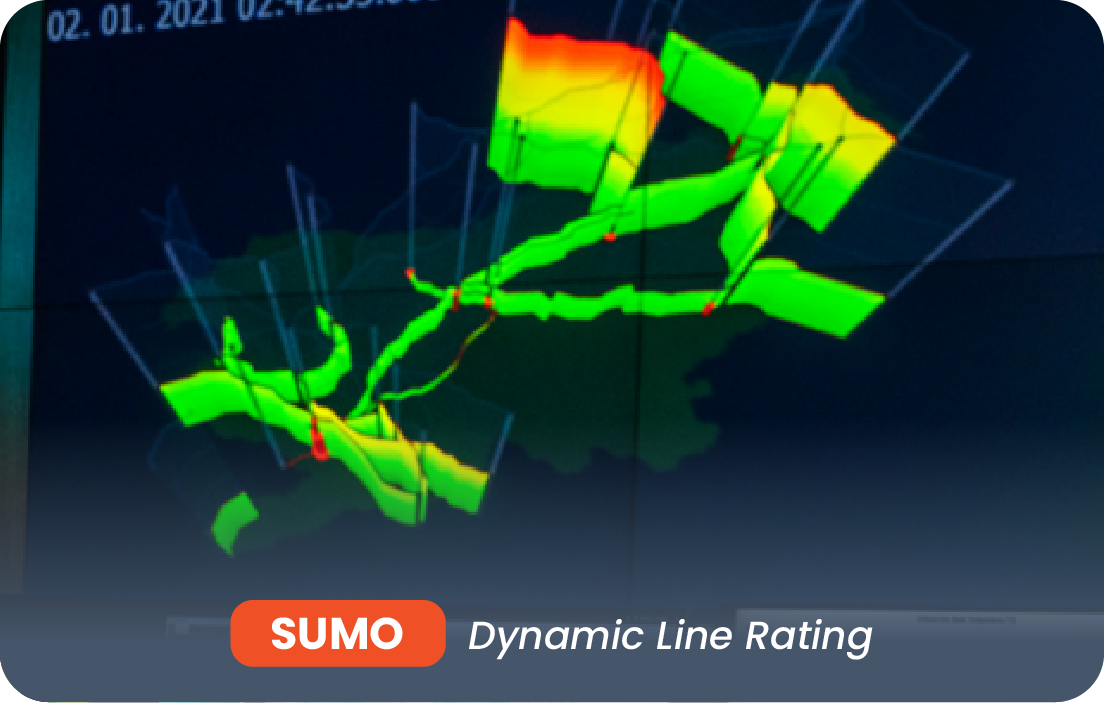
Identify capacity. Quantify headroom. Put it to use.
Static ratings leave usable capacity on the table every day. SUMO gives operators a real-time view of what is actually available across their network.
Ingest weather data
SUMO combines mesoscale and micro-scale weather data to model the thermal environment of each line and component — no sensors required on every span.
Calculate dynamic ratings
Real-time and forecasted ratings are generated for N-0 and N-1 topologies across conductors, transformers, and interconnections — continuously updated as conditions change.
Deliver to operators
Ratings integrate directly with SCADA and EMS systems. Operators see the available headroom and can act on it — with SmartValve redirecting flows to use the capacity SUMO identifies.
Built by operators, for operators
SUMO was developed by ELES, one of Europe's leading transmission system operators, over a decade of real-world use. That operational origin shapes every design decision.
Contactless implementation
No hardware sensors required on every circuit. Rapid deployment at low cost — at distribution and transmission voltage levels.
Real-time and forecasted ratings
Ratings for N-0 and N-1 topologies, updated in real time. Operational planning and market decisions made well ahead of real-time conditions.
Wide-scale network visibility
Coverage of conductors, transformers, phase-shifting transformers, and interconnections — not just individual monitored spans.
FERC Order 881 compliant
The AAR (Ambient-Adjusted Ratings) option meets FERC Order 881 requirements — making SUMO a compliance path for US operators.
Machine learning accuracy
SUMO continuously improves its accuracy based on operational experience and actual network conditions over time.
Easy SCADA/EMS integration
Direct integration with existing control systems. Flexible subscription options configured to each system operator's specific needs.
Ice prevention
An advanced inverse DLR algorithm automatically identifies high icing risk through system alarms, enabling preventive action before outages occur.
Optimized asset lifetimes
Monitors asset health and ensures network components stay within safe operating limits to maximize infrastructure lifetime.
Optional hardware sensors
Conductor temperature sensors can be added as an optional enhancement to increase data granularity in locations where that precision matters.
Built by a TSO over a decade of real operations
ELES, the Slovenian transmission system operator, developed SUMO after concluding that available DLR systems lacked the system-wide coverage and forecasting capability their operations required. They needed software that could predict dynamic ratings in advance — not just read sensors in real time.
ELES built SUMO on the accepted CIGRE dynamic line rating calculation method, using mesoscale weather data as the basis for prediction. Laboratory and field testing confirmed the algorithm was as accurate as a sensor, with much faster, more flexible, and lower-cost deployment. Over a decade of operational use, ELES expanded SUMO across 38% of 400 kV lines, 79% of 220 kV lines, and multiple transformers and interconnections.
Smart Wires launched SUMO in 2022 and it is now deployed across multiple European system operators.
SUMO and SmartValve — more capacity from both
DLR identifies additional thermal headroom above static ratings when conditions allow. But headroom alone is not automatically usable: power still follows the path of least impedance and can remain concentrated on constrained circuits.
SmartValve redirects flows off overloaded paths and onto circuits where SUMO has identified available capacity. The combined impact is consistently larger than either technology alone.
In a study across a constrained 110 kV and 220 kV network, the baseline supported around 350 MW of generation. SUMO alone increased that to around 450 MW. SmartValve alone reached around 500 MW. Together, they supported around 650 MW — an increase of over 300 MW on the baseline.
With both technologies deployed together vs baseline
Up from 350 MW baseline in the study scenario
Source: Smart Wires study. DLR expands the available envelope; APFC makes it usable. SmartValve is also compatible with DLR solutions from other vendors.
SUMO in operation
Real deployments. Confirmed outcomes. Named operators.
From a missed opportunity to system-wide DLR
Slovenia is a key nexus for European power flows. Constantly changing import and export patterns led to congestion on interconnectors even when spare capacity existed elsewhere. ELES identified that static ratings alone were leaving usable capacity on the table every day.
ELES developed SUMO to address this directly. Over the past decade, they expanded it from a pilot to system-wide coverage — refining the algorithm using their own operational experience. The results confirmed both the capacity and the reliability case for dynamic ratings at scale.
Tailored for your unique needs
SUMO is available in two configurations — choose the level that matches your operational requirements and compliance obligations.
Ambient Adjusted Rating (AAR)
Best suited for system operators in the US for compliance with FERC Order 881, or operators who need a straightforward rating system based on ambient temperature.
Dynamic Line Rating (DLR)
Full Dynamic Line Rating system that builds on AAR to deliver real-time and forecasted ratings network-wide, with advanced operational and safety capabilities.


See what capacity is already in your grid
Talk to our team about how SUMO can be implemented on your network.
Contact us